

The Depreciation Strategy That Turns Real Estate Into a Tax Strategy
If you own real estate, a rental property, a commercial building, even the office your business operates out of and your CPA has never brought up cost segregation, you need to read this.
Not because your CPA is incompetent. Most are perfectly capable at what they do.
But cost segregation sits at the intersection of real estate, engineering, and tax law and most general accountants simply don’t live there. It’s a specialized strategy. And like most specialized strategies, it doesn’t come up unless someone in your corner knows to look for it.
Here’s what that silence has likely cost you: tens of thousands, sometimes hundreds of thousands, in tax deductions that were sitting right inside the properties you already own, waiting to be unlocked.
This isn’t a grey area. It isn’t aggressive. It’s a fully IRS-sanctioned strategy that’s been used by sophisticated investors and large corporations for decades. The question isn’t whether it works. The question is why more entrepreneurs aren’t using it.
Ryan owned three properties – a commercial building his business occupied, a short-term rental he’d purchased two years prior, and a small multifamily he’d picked up as a long-term hold.
His CPA was deprecating all three on the standard schedule. The commercial building on a 39-year straight-line. The residential properties on 27.5 years. Clean, compliant, boring.
When Ryan came to us, he was netting just over $1.2M between his business and his real estate income. His tax bill was significant and growing. He’d heard about cost segregation at a real estate conference but assumed it was “for bigger investors.”
It wasn’t.
When we ordered cost segregation studies on all three properties, the results were immediate and dramatic. By reclassifying components of each property into shorter depreciation categories – 5, 7, and 15 years instead of 27.5 or 39 and applying bonus depreciation, we front-loaded over $380,000 in accelerated deductions into the current tax year.
At Ryan’s marginal rate, that was roughly $140,000 in tax savings. In year one. From properties he already owned.
His CPA had filed accurate returns for years. But accurate isn’t the same as optimized.
Let’s break down exactly how this works and why it’s one of the most powerful tools available to entrepreneurs who own real estate.
What Cost Segregation Actually Is
When you purchase a property, the IRS requires you to depreciate it — to spread the cost of the asset over its “useful life.” For residential real estate that’s 27.5 years. For commercial real estate it’s 39 years.
On a $1,000,000 commercial property, straight-line depreciation gives you roughly $25,641 in annual deductions. Spread over nearly four decades.
Cost segregation changes the math by doing something the IRS explicitly allows: reclassifying components of the property into shorter depreciation categories.
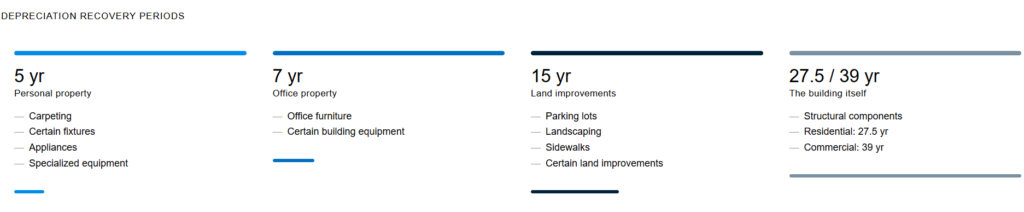
A building isn’t just walls and a roof. It contains:
- 5-year property: Carpeting, certain fixtures, appliances, specialized equipment
- 7-year property: Office furniture, certain equipment attached to the building
- 15-year property: Parking lots, landscaping, sidewalks, certain land improvements
- 27.5/39-year property: The structural components — the building itself
A cost segregation study, performed by an engineer with tax expertise, identifies which components fall into which category. The result is that instead of depreciating everything over 27.5 or 39 years, you’re accelerating the depreciation on 20%–40% of the property’s value into the first 5–15 years.
Combined with bonus depreciation, which for recent years allowed 100% of qualifying assets to be deducted in year one, the front-loaded tax benefit can be extraordinary.
Bonus Depreciation: The Accelerant
Bonus depreciation is what turns cost segregation from a useful strategy into a transformative one.
Under the Tax Cuts and Jobs Act of 2017, 100% bonus depreciation was available on qualifying property through 2022. Since then it has been phasing down 80% in 2023, 60% in 2024, 40% in 2025, and 20% in 2026, before sunsetting entirely under current law.
This phase-down creates urgency. Every year you wait, the accelerant weakens.
The practical impact: on a $1,000,000 commercial property with $250,000 in components qualifying for 5 and 15-year depreciation, 60% bonus depreciation in 2024 means $150,000 in deductions available in year one — versus roughly $6,400 under straight-line.
That’s not a rounding error. That’s a strategy.
The Real Estate Professional Status Play
Here’s where it gets even more powerful for the right entrepreneur.
By default, rental losses are classified as passive losses, meaning they can only offset passive income, not your active business income. For a high-income entrepreneur, this limits how much of that accelerated depreciation actually reduces your tax bill.
Real Estate Professional Status (REPS) changes that entirely.
If you or your spouse , qualify as a real estate professional under IRS guidelines (750+ hours annually in real estate activities, with real estate being your primary professional activity), your rental losses become active losses. They can offset your W-2 income, your business income, your capital gains, all of it.
For a couple where one spouse manages properties while the other runs a high-income business, this combination, cost segregation plus REPS, can eliminate six figures in tax liability.
The requirements are specific and the documentation matters. But for the right family structure, this is one of the most powerful plays in the entire tax code.
The Short-Term Rental Loophole
Don’t qualify for full REPS? There’s another path.
Short-term rentals, properties rented with an average stay of seven days or fewer, are not automatically classified as passive activities under IRS rules. If you materially participate in the management of your short-term rental (which most active owners do), the losses are treated as active losses from day one.
This means cost segregation on a short-term rental can generate active losses that offset your ordinary business income, without needing to meet the full REPS threshold.
It’s one of the most underutilized tax positions available to entrepreneurs who are already investing in real estate or are considering it.
Who This Works Best For
Cost segregation isn’t for every property or every situation. It delivers the most impact when:
- The property was purchased for $500,000 or more
- You have significant taxable income to offset, the deductions need somewhere to go
- The property was purchased or renovated in the last few years (studies can be done retroactively)
- You have active income to shelter, either through REPS or the STR strategy
- You’re thinking about long-term holds, the recapture math works better when you’re not planning to sell in two years
The cost of a study typically runs $5,000–$15,000 depending on property size and complexity. On a property generating $100,000+ in accelerated deductions, the ROI on that study is immediate and significant.
THE RESULT
Ryan’s $140,000 in first-year tax savings didn’t come from changing his business, selling assets, or taking on more risk. It came from looking inside properties he already owned and applying a strategy that had been available to him for years.
The properties didn’t change. The income didn’t change. The structure did.
That’s the pattern we see over and over: entrepreneurs who are already winning, already owning real estate, already building wealth — who simply haven’t had someone connect the strategy to their specific situation.
Cost segregation is one piece. REPS is another. Bonus depreciation is the accelerant. Combine them correctly, inside the right entity structure, and real estate stops being just an investment, it becomes one of the most tax-efficient wealth-building tools available anywhere in the code.
THE BIGGER PICTURE
Real estate tax strategy doesn’t live in a silo. The depreciation you generate here can offset income from your business. The entity you hold property in determines how losses flow. Your retirement contributions, your cash flow system, your wealth transfer plan, all of it connects.
This is exactly why collecting individual strategies from podcasts and conferences only gets you so far. The real leverage is in how these pieces work together.
At Vital Wealth, we don’t hand you one play and call it a day. We build the system.
At Vital Wealth, we work with a focused group of clients who are scaling fast and want a long-term partner who understands the full picture – income, structure, cash flow, and wealth building, not just year-end compliance.
If that’s you, we’d like to have a real conversation.
Schedule a Consultation | Vital Wealth → Schedule a Consultation | Vital Wealth
We review every inquiry personally. If we’re a fit, we’ll show you exactly what’s possible for your situation.